Three Days, One Story That Matters
Some stories stay with you longer that the mountains
I sat on the plane from Doha to Kathmandu, watching the Himalayan peaks rise above the clouds, thinking I was heading into another holiday in my beloved Nepal. At that moment, I had no idea how wrong I was.
I arrived in Kathmandu five days before my main trek, which was cycling the Annapurna Circuit — the second most famous destination in Nepal after Everest Base Camp. While waiting for my main guide to return from another trek, I decided to go cycling around Kathmandu and asked for a local cycling guide to accompany me.
Kathmandu is a place to love and hate. Thamel, the touristic district, is an enclave — a privileged zone of shops, restaurants, and cafés, with more tourists than locals on the streets. However, even there, walking means merging into a constant flow of cars, motorbikes, and bicycles. But once you leave Thamel, the city changes quickly. Nepal is a very poor country, and you see it immediately. Tiny shops selling “everything” line the streets, one next to another. People sit outside waiting for customers. Vegetable sellers display their produts directly on the ground or carry it on bicycles. There are no more tourists — only people in flip-flops, sitting in front of shops, hurrying somewhere, or simply waiting. Buildings range from solid houses to shelters made of metal plates. Dust, pollution, and trash are part of daily life. Riding through these streets makes two things clear: for many people here, life is a daily fight for survival — and I am a privileged visitor.
The question stayed with me: can I do anything more than just pass through?
In one of Thamel’s hidden streets, inside a small bike shop, I met my cycling guide: Harka Lama. Sunam, a bike mechanic from the Cog Bike Shop was finishing setting up my bike after the flight transfer, and we discussed possible routes and ride durations. Harka appeared calm and professional, with the quiet confidence of a strong rider. Only later would I understand how strong he truly is — and how much that strength had cost him.
For our first ride, we headed west of Kathmandu, straight into the morning traffic. Riding close on his wheel — just centimeters away — was the only way not to lose contact. Kathmandu feels like a city that started sprinting before it learned to walk, growing so fast there was no time for structure. The streets are chaotic, loud, dusty, and oddly hypnotic. Pedestrians, rickshaws, motorbikes, and honking cars weave through what feels like an improvised urban choreography. It’s messy, raw — and somehow it works.
Once the city noise faded, we stopped at a small roadside bar for coffee. It was there that Harka shared a few words about himself and, almost in passing, mentioned that he was a cancer survivor and that he was working on a major project.
The climb toward Dahachok Danda followed — narrow roads, steep ramps, prayer flags overhead, and finally a restaurant at 1,874 meters with views across the Kathmandu Valley. Throughout the ride, Harka stayed patient and attentive. These roads are part of his training terrain. After surviving cancer, he returned to cycling and trained relentlessly. Two years later, he was racing again — and winning. Three-time national cross-country master champion. Multiple victories at the Yak Attack on the Annapurna Circuit. Finisher of Cape Epic and races in the Pyrenees. The list was astonishing.
The climb, lunch with Himalayan views, and a flowing single-track descent felt unreal — a reminder that only a few kilometers from Kathmandu’s chaos, silence still exists. Like Harka’s story, it all felt unbelievable. There was no hesitation about riding again the next day.
North-East of Kathmandu lies Shivapuri National Park, a protected military area that hides the main water source for the valley. Getting there means riding again through the city — and again seeing how differently people live. Some homes are built from a few blocks with metal roofs, animals standing beside them, laundry hanging outside, debris everywhere. It barely looks like a place people could live — until children appear, adults sit nearby, someone washes dishes at a shared well by the river. A few hundred meters further, large houses rise, shops on the ground floor, solar panels on the roofs. The contrasts are striking.
The climb into the park was steady and quiet, partly asphalt, deep in the forest, passing military buildings. At the final checkpoint, the view over Kathmandu was wide and hazy, already dulled by pollution at the end of November. We continued on a narrow trail, waterfalls on one side, sunlight opening over the valley on the other. Flowing down the trail, one thought kept returning: how does someone come back from what feels like a death sentence?
People sometimes admire or congratulate me for cycling trips in the Himalayas. But it never feels deserved. This is not a struggle or a fight — it is a choice, a holiday. Stories like Harka’s are different. They deserve attention. Perhaps my role here was not to achieve anything, but simply to listen — and to pass his story on.
I still had one more day before heading to the Annapurna Circuit. Naturally, I asked Harka to guide me again — this time to Jamacho, just a few kilometers from Thamel. Entering the forest felt like teleportation. One moment you fight Kathmandu traffic; the next you breathe freely, ride sandy trails, hear birds, and watch sunlight filter through dense jungle. We had a long climb ahead. I found my rhythm. Silence.
Harka had been diagnosed with transitional cell carcinoma of the urinary bladder. He underwent tumor resection followed by further treatments. Two years of physical, mental, and financial struggle — during the COVID period — before even considering a return to cycling.
Imagining that path was difficult. Ahead on the trail, he waited at a bend, smiling, asking if I need a short break.
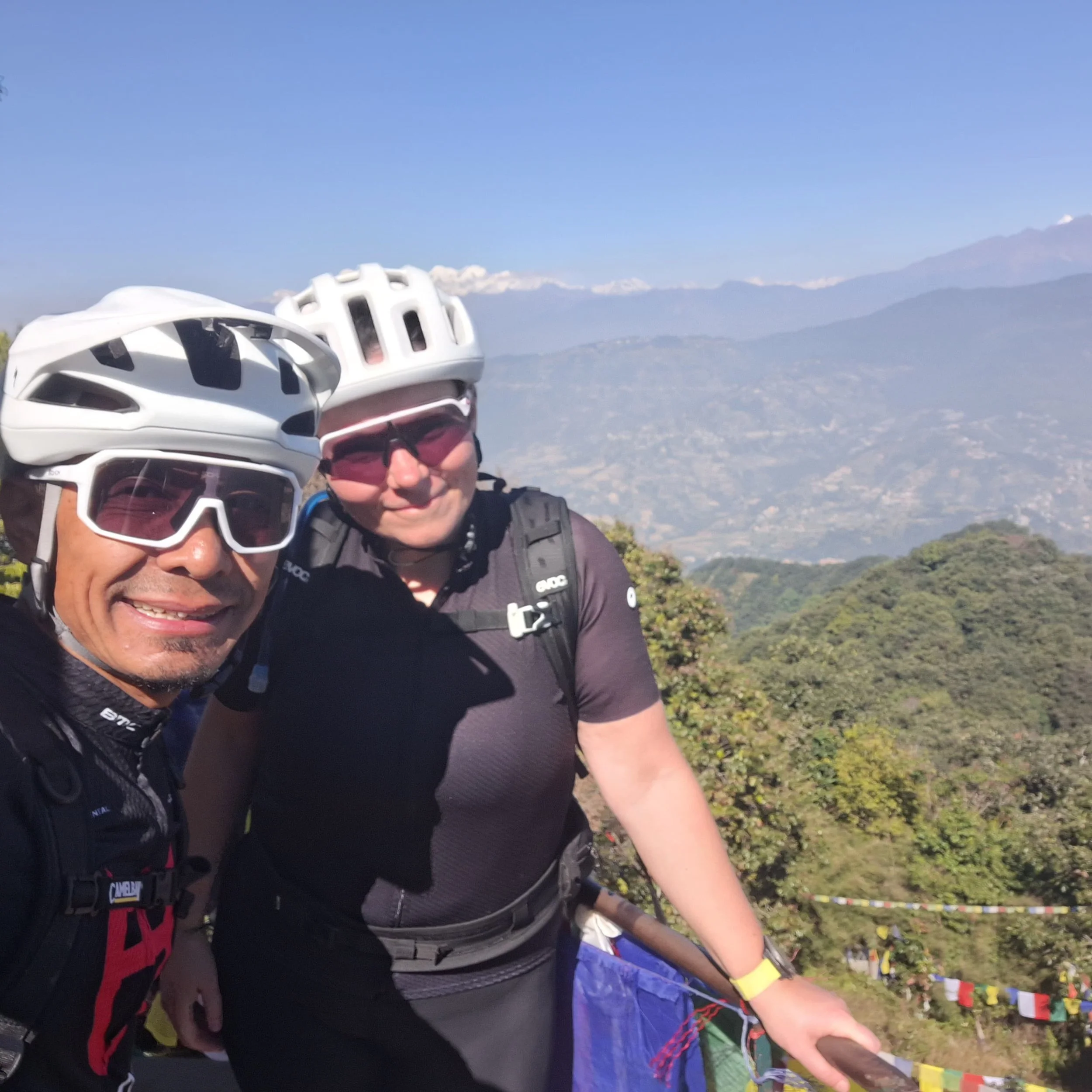
At the summit, beside a small Buddhist stupa covered in prayer flags and overlooking the Himalayan range, he explained what cycling meant to him. It wasn’t about performance, but about reclaiming life. Weak at first, fragile, afraid of recurrence, he began slowly — it was his physiotherapy and psychotherapy. What followed was not just a comeback, but a remarkable transformation.
Later, over lunch, I learned why his project matters so deeply. Since 1990, the cancer burden in Nepal has doubled. Treatment costs — around $3,700 per year — are far beyond what most patients can afford. Access to healthcare and insurance is largely reserved for those with financial means. Most people must pay for every hospital service themselves. Many people don’t get tested at all. Some lack awareness. Others live too far from hospitals. And even when cancer is diagnosed, treatment is often financially impossible. Faced with that reality, I’m not sure I would even want to know.
Together with another cancer survivor, Kabita Chitrakar, and in collaboration with Cycle Culture Community and Dhulikhel Hospital, Harka created a charity cycling project to support cancer patients in Nepal.
Starting January 1st, 2026, they will cycle for 30 days across Nepal, from east to west — covering 1,800 kilometers and 52,000 meters of elevation gain along the Mid-Hill Highway. Along the way, they will organize awareness programs, community outreach activities, and health camps to support underprivileged and financially vulnerable cancer patients.
To learn more about Harka: Harka Lama website.
This is where you can help.
Donate to support the Cancer Survival Support Fund - https://www.gofundme.com/f/cycling-for-cancer-survival-support
Ride with them for one or several stages if you are in Nepal in January - https://ride-for-life-dun.vercel.app/
Share this story, helping their message travel further than they can ride
Even small contributions matter in a country where access to diagnosis and treatment is out of reach for many.
When I first came to Nepal, the goal was simple: to see the Himalayas. This was my fourth visit. Each time, the mountains remain extraordinary — but it is the people and their stories that stay longest. I still come for adventure and movement, but not only for that.
Cycling through Kathmandu, witnessing both hardship and resilience, and meeting people like Harka changed this journey. His story deserves to travel further than these three days — and that is why I share it here.
